November 6, 2026 · Amanda Glaser
Legal Isn’t Enough: Setting Personal Minimums and Sticking to Them
Just because it’s legal doesn’t mean it’s smart. This guide shows you how to set and actually stick to personal minimums that go beyond the FARs—using the PAVE checklist and real examples for both PIC and instructor flying.
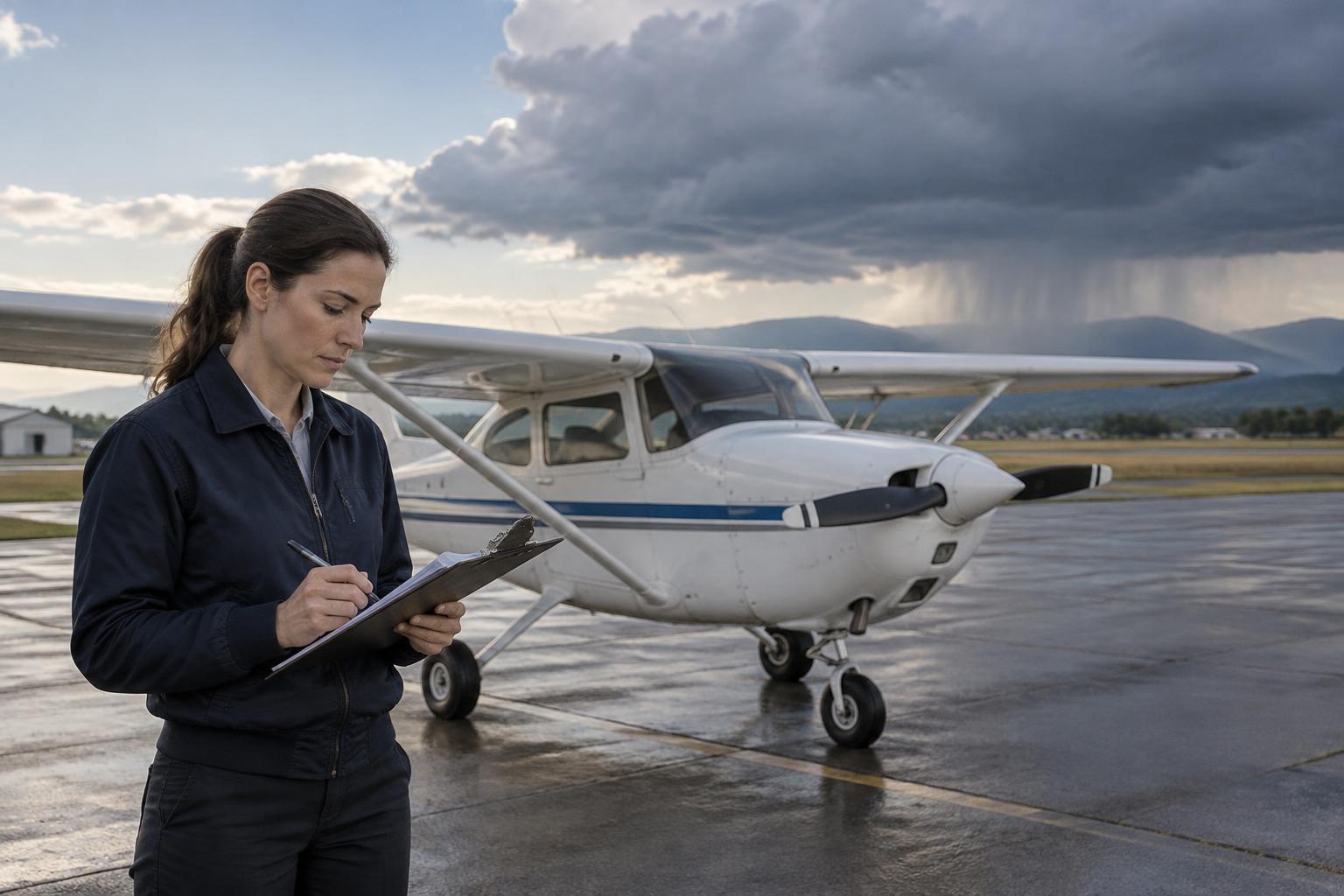
"To fly or not to fly, that is the question…" - Shakespeare, probably.
When I am planning a flight, whether I am flying with a student or on a personal trip, I utilize many resources - a good weather briefing, charts to understand terrain and routing options, FBO services, etc. One thing I always use as part of that go/no go decision making is my personal minimums document.
My personal minimums are there to keep me and my passengers safe. For me, the flight has to be legal to even be considered … but just because something is “legal” doesn’t always make it a good idea. I need to feel confident that I can execute it safely, and that’s where my minimums come in.
How to Get Started Defining Your Minimums
So where to start? There are a number of tools out there that can help you create your starting point. The FAA has a worksheet you can use to help guide you, or you can create your own. (https://www.faa.gov/sites/faa.gov/files/2022-01/Personal-Minimums.pdf)
I like to use the PAVE framework, and I have provided some examples to help you think of the variety of items you can consider. I also set a few distinctions for flights where I am the pilot flying versus acting as the instructor. My instructional minimums are higher in some areas because I need additional margin to be able to teach, monitor, and let students make mistakes without compromising the safety of the flight.
(*Note - Examples with numbers are provided to help with ideas but these are not blanket recommendations for every pilot. Your numbers and limitations must be based on your own experience and proficiency.)
1) Pilot
- IMSAFE Checklist completed before every flight
- Slept at least 6 hours within the past 24 hours & not feeling fatigued
- Recency (examples: 3 hours flown in past 30 days if going IFR or carrying passengers, 2 approaches in past 60 days if expecting IMC)
- Proficiency (examples: not more than 12 knots of crosswind component, no more than 20 knot gusts at departure or destination, 4000+ft ceiling height / 5 sm visibility if going VFR, 500 ft ceilings and 1 sm of visibility for IFR as a pilot and 800 ft / 1 sm as an instructor, no circling or IMC instruction at night)
- Comfort for myself and passengers (examples: No legs longer that 3 hours, review potential for turbulence, heat/time of day)
2) Aircraft
- Proficiency in the aircraft & with the avionics (examples: checked out and comfortable with navigation systems and instruments, at least 2 approaches in the aircraft in the past year before going into IMC)
- Comfort with airworthiness beyond “is the aircraft legal to fly” (examples: review open squawks, nothing inop or damaged that I feel is necessary for my flight)
- Fuel reserves beyond what is needed to reach my destination and alternate (examples: at least 45 min for day or 1 hour for IMC/night, confirmed fuel available at destination)
- Required or desired equipment is present (examples: Autopilot if >2 hours of IMC expected or have another qualified pilot, WAAS capable GPS)
3) Environmental Factors
- Appropriate preflight planning done for every flight (NWKRAFT) & current weather briefing prior to takeoff
- Required takeoff conditions: In many cases, a Part 91 pilot can legally take off in 0/0 conditions, but that does not make it a good idea. I won’t take off from an airport if I can’t come back and immediately do an approach to land.
- Storm distance tolerance … the FAA says stay at least 20 miles away. If your plane is not equipped with weather RADAR (and no, ADS-B in weather is not up to the minute like what you would find on a commercial flight), does that distance change for you?
- Freezing and icing considerations if flying in a plane without icing equipment: how warm at cruising altitude does it need to be across your route for you to fly in IMC?
- Expected terrain (examples: mountain flying course before flying in the Rockies, no more than two of the following: mountains, nighttime, or IMC)
4) External Pressures / Other
- Always have a backup plan if it’s somewhere you really need to go (commercial flight, rental car, etc).
- Are passenger considerations causing you to make choices you wouldn’t otherwise?
How do you use these once you have them documented?
A best practice is to quickly review them when planning each flight to make sure you are staying within them. You can print them or keep them as a document on your EFB or as a note on your phone or tablet. If the planned flight is outside of those minimums, change the plan to something that does fit them or cancel. These are a non-negotiable for you, even if the negotiation is only with yourself. So if the crosswind is at 11 knots vs your maximum of 10 knots, you go at a time when the weather is more favorable or you make another plan.
Review your minimums on a non-flying day when you don’t have the pressure of somewhere to be or a passenger you don’t want to disappoint. Also, any time you take a checkride is also a good time to review and make updates, as these limitations will expand and contract over time.
Personal minimums only work if you respect them even when they are inconvenient. Set them thoughtfully, keep them updated, and don’t negotiate them right before takeoff. Make the decision before the pressure starts.