April 10, 2026
How Do Airplanes Fly? The Science Behind Flight
A deep dive into the aerodynamics of flight.
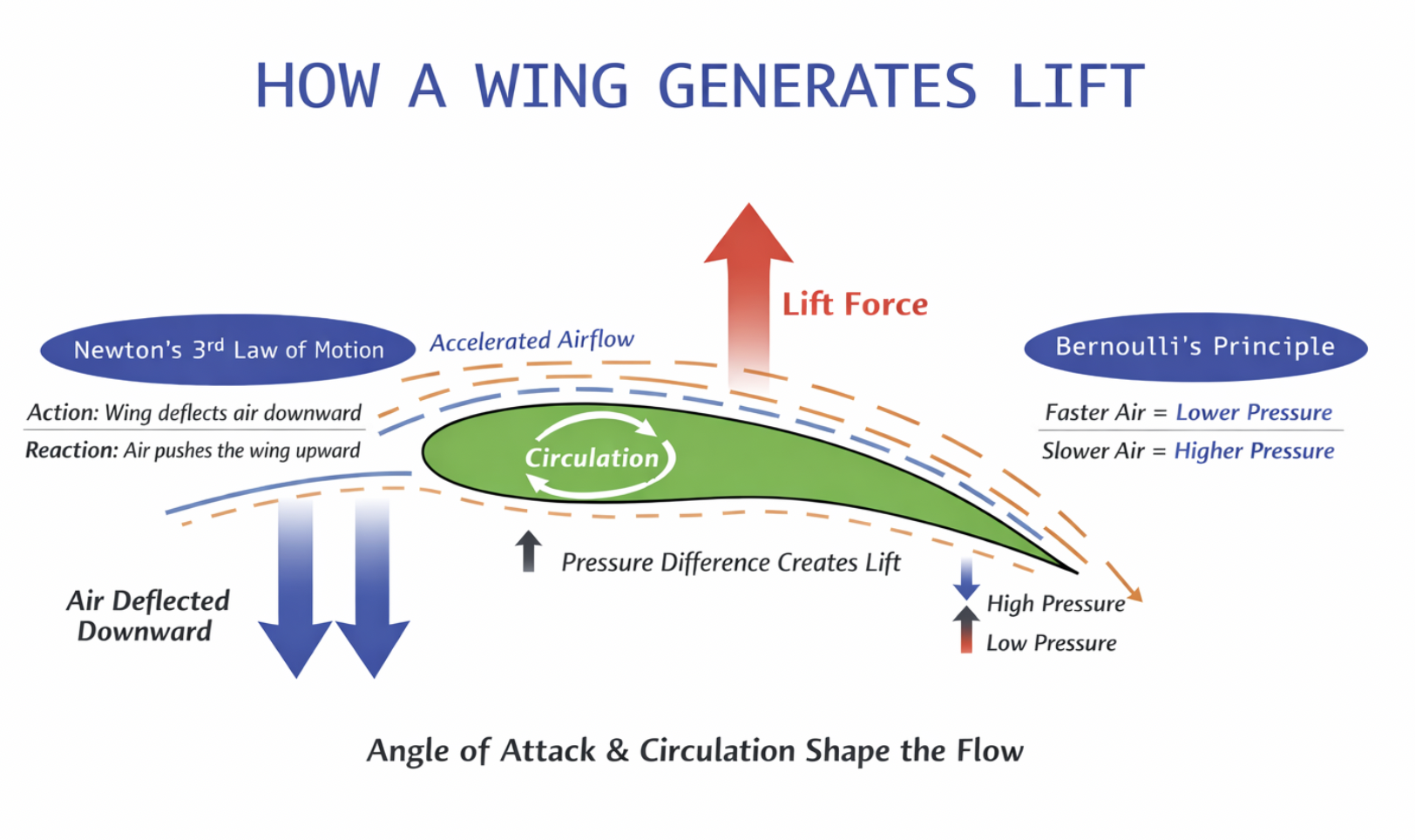
The simplest of all explanations:
The reason a wing generates lift is because of Angle of Attack, the angle of relative wind against the wing. To simplify more, it's the wind deflection of the wing.
The Two Pieces of Physics Behind Lift
Two different effects describe what’s happening when a wing produces lift. They’re often presented as competing explanations, but they’re really just two views of the same physics.
Bernoulli’s Principle
Bernoulli showed that when a fluid speeds up, its pressure drops. A wing is shaped so that air flows faster over the curved top surface than it does under the bottom. Faster air on top means lower pressure; slower air underneath means higher pressure. The difference pushes the wing upward.
A simple way to picture it: the air above the wing is pulling up harder than the air below is pushing up.
Newton’s Third Law
Newton’s law says that every action has an equal and opposite reaction. A wing meets the airflow at a slight angle, and in doing so, it pushes that air downward. The reaction is an upward force on the wing — lift.
Bernoulli describes the pressure pattern. Newton describes the change in momentum. Together, they explain the whole story.
Angle of Attack: The Real Key
Angle of attack (AOA) is the angle between the wing’s chord line and the relative wind. And here’s the part every pilot has to truly absorb:
Lift depends on angle of attack, not airspeed by itself.
Raise the AOA → lift increases (up to a limit)
Raise it too far → airflow separates from the wing → stall
A stall can happen at any speed or attitude if the critical AOA is exceeded
Most GA wings reach that critical angle somewhere around 15–18 degrees. Beyond that, the smooth airflow breaks down, drag spikes, and lift falls off sharply.
What the Elevator Really Does
The elevator is the movable surface on the horizontal stabilizer. Pulling back deflects the elevator upward, pushing the tail down and pitching the nose up. Pushing forward does the opposite.
But the important point is this: the elevator isn’t “lifting” the airplane — it’s changing the wing’s angle of attack.
Pull back → higher AOA → more lift (until you get too close to the critical AOA) Push forward → lower AOA → less lift and more airspeed
That’s why pitch control is so central to managing airspeed and performance in every phase of flight.
Why the Rudder Matters
If the elevator handles pitch, the rudder handles yaw — the left‑right rotation around the vertical axis.
You can roll into a turn with ailerons alone, but without the rudder, the airplane won’t turn cleanly.
Adverse Yaw
When you roll right, the left aileron goes down, increasing lift on the left wing. More lift also means more induced drag, which pulls that wing backward and yaws the nose left — opposite the direction you’re trying to turn.
That’s adverse yaw, and it’s why coordinated rudder input is essential.
Coordinated Flight
A coordinated turn keeps the slip/skid ball centered. To do that, you add rudder in the direction of the turn to counteract adverse yaw.
This isn’t just about comfort:
Uncoordinated flight near stall speed is dangerous. A skidding turn in the pattern can lead to a spin.
It wastes performance. Slips and skids add drag and hurt climb rate.
It’s a hallmark of good airmanship. Examiners notice coordination immediately.
Bringing It All Together
Every time you fly, these pieces work together:
Bernoulli and Newton describe how the wing produces lift
Angle of attack determines how much lift the wing can make
The elevator controls AOA and therefore airspeed and lift
The rudder keeps the airplane coordinated and safe
Mastering these fundamentals isn’t just academic — it’s what keeps airplanes flying the way we expect them to. Understanding them makes you a more confident, more precise, and ultimately safer pilot.