November 15, 2026 · Brian Blum
Continuing Education through the WINGS Program
Surviving after you earn your Private Pilot Certificate.

You’ve probably seen this histogram or one like it. It shows the number of fatal accidents among pilots plotted against their flying experience. You’ll notice that while pilots are acquiring their first 50 hours of flight time, they have relatively few fatalities but once they get past that point, more of them die—and the higher number of deaths continues until the pilots who survive long enough gain more experience.
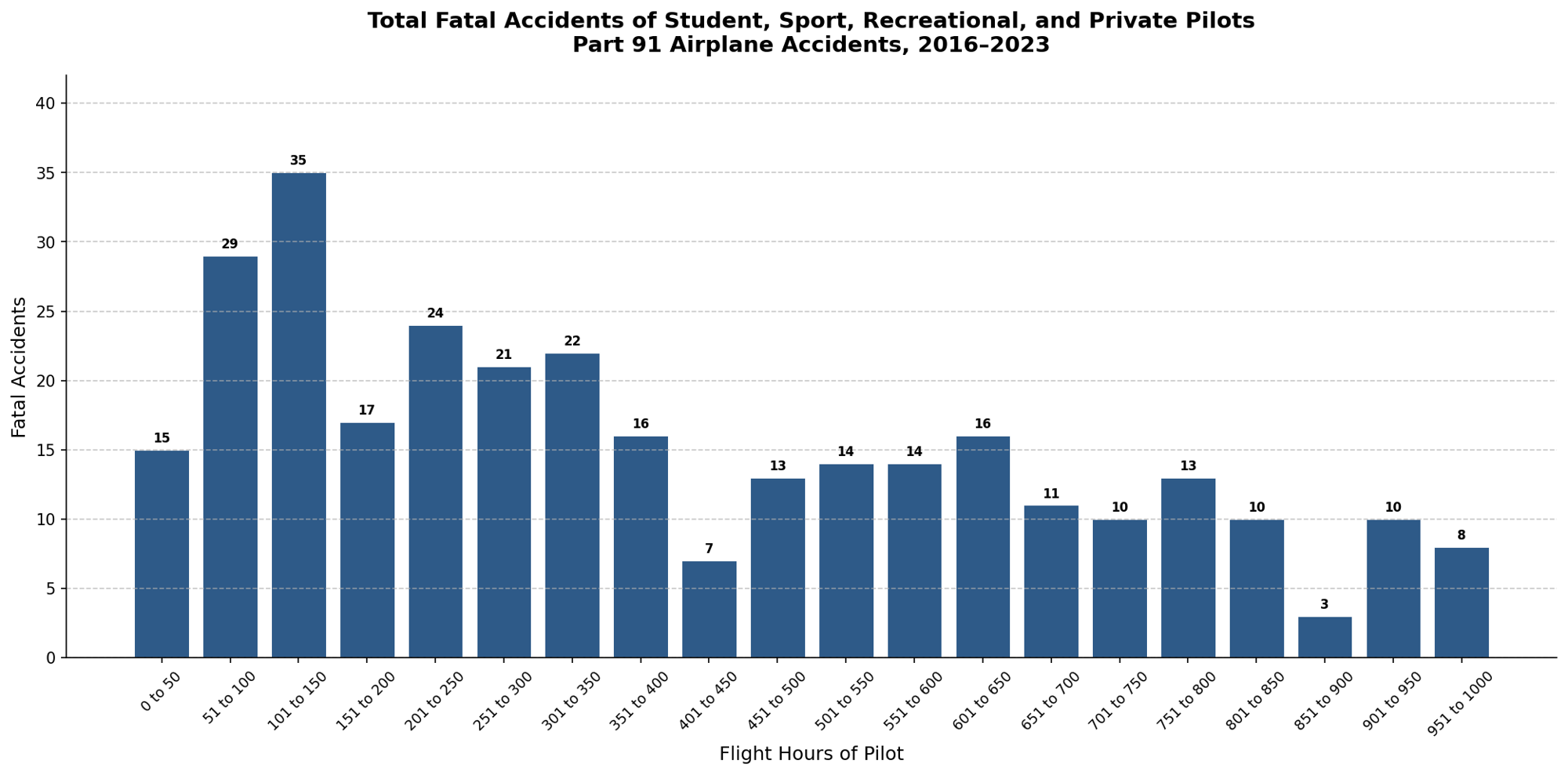
Almost no one earns a pilot certificate with fewer than 50 hours of flight experience, so it’s safe to say that virtually all of that first experience column consists of student pilots taking training with experienced instructors and student pilots exercising limited short-term solo privileges while being trained and overseen by experienced instructors. The second column is where most students earn their initial certificates, and for the first time they’re exercising their own independent judgment without oversight from their experienced instructors. That’s the point where more of them die—and the higher number of deaths continues until the pilots who survive long enough gain more experience.
So, what could a pilot do to reduce his immediate fatality risk while developing the aeronautical experience that will reduce his later risk? Flying with an instructor does exactly that; if an instructor is in an experience column with fewer fatal accidents, you’re at a similar risk while flying with him, even if your own experience column is worse.
Recognizing that flight training makes pilots safer and gives them flight experience in a safer way, 14 CFR 61.56 offers several training-oriented alternatives to the biennial requirement that every pilot take a flight review. One such alternative is to upgrade your license or add a new rating; getting your instrument rating or commercial certificate, or adding privileges in a new category or class requires that you take training and a skills assessment. Another alternative is to achieve a certain milestone in the FAA’s WINGS program, which requires training and skills assessments.
FAA Safety Team’s WINGS Program
Specifically, the FAA’s WINGS program offers a vast and ever-expanding catalog of flight and knowledge activities from which pilots may choose, at all different levels, and in all different categories and classes of aircraft. If you’ve ever taken the FAA’s free, self-paced, online courses about flying in the Washington D.C. SFRA or past the New York City skyline in the Hudson River Exclusion Zone, you’ve already done a WINGS activity! If you attended presentations or “flew” simulators at EAA’s AirVenture Oshkosh, you may well have done WINGS activities then, too.
You can even get WINGS activity credit for certain accomplishments such as earning certificates or ratings or taking flight reviews. If you volunteer with the Civil Air Patrol, their annual checkout flights can count as credit for WINGS activities, too.
The program divides all of these various activities down into basic, advanced, and master levels, roughly corresponding to the skills expected of private pilots, commercial pilots, and ATP/CFI certificate-holders, respectively. Within each level, activities are further subdivided into three knowledge topics and three flight topics. For example, at the basic level the three knowledge topics are risk management, aircraft operations, and electives, and the three flight topics are operating at airports, operations away from airports, and electives. Earning one activity credit in each of the six topics at any level is called earning a “phase,” and is the milestone that counts as the alternative to taking a flight review. I should also note that activities may offer credit in one or more topics, so for example, I attended a safety seminar which offered credit for both basic-level knowledge topic 3 and master-level knowledge topic 2. If you request WINGS credit for having earned a new certificate or rating or for taking a flight review, it will include credit for a full phase worth of flight and knowledge topics.
Besides the safety and training benefits from participating in WINGS, some insurance companies recognize the value and offer premium discounts for completing phases. Ask if yours does! Lastly, you can get prizes for your participation, including WINGS lapel pins and sweepstakes entries.
WINGS for Instructors
To incentivize instructors to evangelize the WINGS program, there’s also a path for instructors to update their “recent experience end dates” (which used to be called their CFI expiration dates) through their participation in the WINGS program. The CFI must have completed a WINGS phase himself within the previous 12 months, to be eligible, and during the previous 24 months, the CFI must have evaluated at least 15 WINGS-accredited flight activity credits at any level during which the CFI evaluates at least five different pilots.
Getting Started with WINGS
To get started, you’ll need to create a free account at www.FAASafety.gov. Once you’re in, you can simply click through on your own, or you can use the FAA WINGS Manual as something of a guided tour. You can also find a lot of the thinking behind the WINGS program described in Advisory Circular 61-91K if you’re so inclined.
When searching through the list of activities, the database includes WINGS activities for pilots, AMT activities for mechanics, and even staff training for the FAA Safety Team representatives who administer these programs, so filter for just the ones applicable to you.
Conclusions
Whether you’re simply looking for excuses to go flying or are genuinely interested in the safety benefits that come from a program of more frequent continuing education than a mere biennial flight review, the WINGS program is a terrific option. Pilots can take knowledge training by completing self-paced online courses or by attending presentations and seminars in person or through Zoom. Pilots can customize flight activities to their specific interests, choosing from different aircraft categories and classes, different levels of proficiency, and different specific areas of focus (within the required topics). Used correctly, there’s no rush or pressure to get everything done – any completed activities may be applied for phase-completion credit anytime within 12 months, so it’s easy to stay current if you make it a part of your regular routine to take a knowledge course every couple of months and to fly an activity with an instructor every couple of months. You’ll be a better pilot for it and you may even live longer.